Does better electrostatics improve RBFE?
Published on August 20, 2026

We tested electrostatic-embedding MLIP/MM across five targets selected before seeing these results, with three replicates per edge and matched protocols against classical GAFF2 and our own mechanical-embedding AceFF-1.0.
On TYK2, ΔΔG RMSE fell from 0.86 kcal/mol with GAFF2, and 0.77 with mechanical embedding, to 0.45. On CDK2, Thrombin, p38 and JNK1, the method was broadly comparable rather than better.
| System | Model | RMSE | MAE | Kendall τ | Spearman ρ |
|---|---|---|---|---|---|
| TYK2 | AceFF-RESP-1 | 0.45 | 0.34 | 0.72 | 0.88 |
| TYK2 | GAFF2 | 0.86 | 0.64 | 0.54 | 0.69 |
| TYK2 | AceFF-1.0 | 0.77 | 0.57 | 0.64 | 0.83 |
| CDK2 | AceFF-RESP-1 | 1.29 | 1.01 | 0.33 | 0.43 |
| CDK2 | GAFF2 | 1.50 | 1.21 | 0.20 | 0.25 |
| CDK2 | AceFF-1.0 | 1.32 | 0.88 | 0.40 | 0.50 |
| Thrombin | AceFF-RESP-1 | 1.37 | 1.08 | 0.41 | 0.66 |
| Thrombin | GAFF2 | 1.42 | 1.12 | 0.41 | 0.58 |
| Thrombin | AceFF-1.0 | 1.36 | 1.00 | 0.18 | 0.25 |
| p38 | AceFF-RESP-1 | 1.01 | 0.78 | 0.66 | 0.82 |
| p38 | GAFF2 | 1.11 | 0.81 | 0.62 | 0.81 |
| p38 | AceFF-1.0 | 1.09 | 0.87 | 0.65 | 0.84 |
| JNK1 | AceFF-RESP-1 | 1.15 | 0.91 | 0.37 | 0.49 |
| JNK1 | GAFF2 | 1.13 | 0.89 | 0.34 | 0.45 |
| JNK1 | AceFF-1.0 | 1.09 | 0.86 | 0.37 | 0.49 |
The conclusion is selective: dynamic electrostatics can help when static charges are the limiting error, but they are not the dominant error source everywhere.
What electrostatic embedding changes
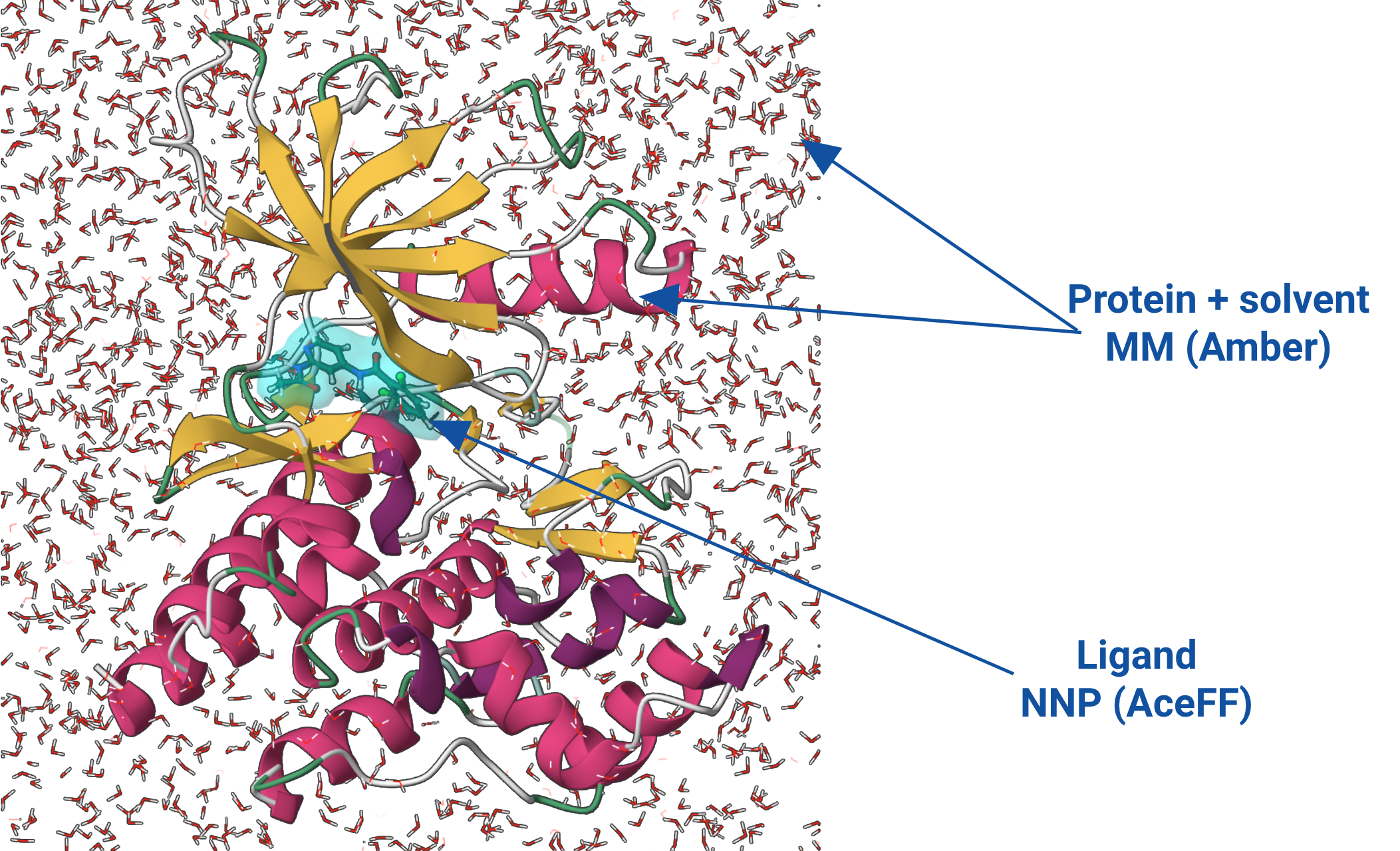
Mechanical embedding — the approach behind our earlier QuantumBind®-RBFE work — improves the ligand's internal energy, but its interactions with the protein and solvent still use fixed charges. If the electrostatics itself is the bottleneck, fixing the ligand's internal physics alone can't help.
Our electrostatic scheme predicts geometry-dependent RESP
charges alongside energies and forces, from a single network we
call AceFF-RESP-1. Those charges modify the
direct-space PME interaction with the environment, while Thole
damping prevents divergences during alchemical
transformations.
This is the specific physical change being tested. It is not a fully polarizable protein model — the protein and solvent still carry fixed charges; only the ligand's charges move.

Why the difference?
TYK2 is famously a "well-behaved" system: a rigid pocket, well-parametrized ligands, minimal induced-fit. That's exactly the regime where static charges are the accuracy bottleneck, so replacing them with dynamic, conformation-aware RESP charges closes the gap directly. The other four targets are bigger, more flexible, or carry net charge, and static charges are probably not what's limiting accuracy there.
One hypothesis is that a rigid, well-parameterized pocket leaves static ligand charges as a dominant remaining error, while in larger, more flexible, or charged systems, sampling and other force-field errors dominate instead. Five targets aren't enough to establish that — rigidity, ligand size, and net charge all vary together across this set — but they're enough to show that the benefit is real and target-dependent, not universal.
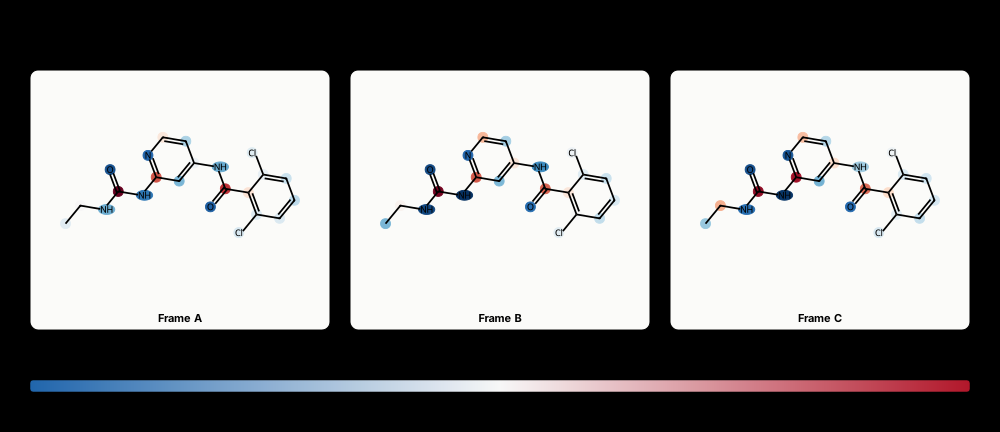
Partial charges are usually drawn as fixed labels on a molecular structure, but they aren't fixed in this model. Most predicted atomic charges on one TYK2 ligand varied by less than 0.1e across an 18000-frame simulation, while a couple of nitrogen atoms near the urea linkage varied by up to about 0.4e:
Making it operational
More detailed physics isn't useful for RBFE if it can't be run across a full alchemical campaign. We evaluate all λ-replicas together in a single batched GPU inference step, which produces only an approximate 2× slowdown in simulation steps per second. Combined with the 2 fs timestep required for MM/MLIP (versus 4 fs for classical MD), the estimated effective overhead is roughly 4× classical MD.
That makes the method feasible in a production workflow. Whether the additional cost is worthwhile remains target-dependent.
The full preprint, with all the methodological details and the rest of the benchmark results, is out: https://arxiv.org/abs/2608.13355. The model is available on Hugging Face: https://huggingface.co/Acellera/AceFF-2-RESP-1.
Want to know more or try it on your own targets? Get in touch at info@acellera.com.
Reference
Semelak, J. A.; Pickering, I.; Huddleston, K.; Olmos, J.; Grassano, J. S.; Clemente, C. M.; Drusin, S. I.; Marti, M.; Gonzalez Lebrero, M. C.; Roitberg, A. E.; Estrin, D. A. Advancing Multiscale Molecular Modeling with Machine Learning-Derived Electrostatics. J. Chem. Theory Comput. 2025, 21 (10). https://doi.org/10.1021/acs.jctc.4c01792