
Advancing Drug Discovery with AceFF™ 1.0
Published on January 3, 2025
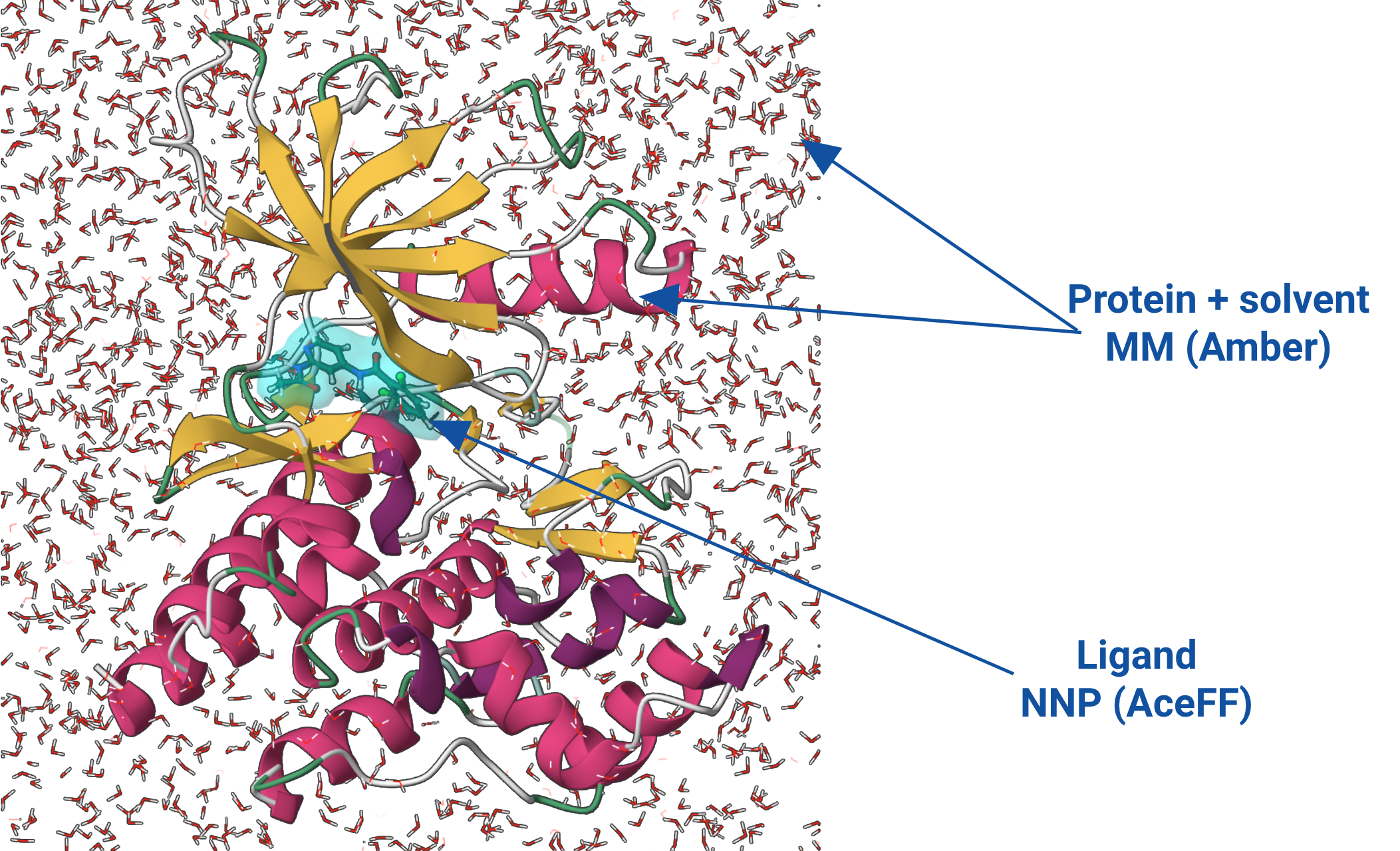
We are introducing AceFF™ 1.0, a neural network potential designed to model molecular energies and forces. It can be used in molecular simulation and mixed neural network potential and molecular mechanics workflows.
What Are Neural Network Potentials (NNPs)?
Neural Network Potentials (NNPs) are a class of machine learning models that predict molecular interactions by learning quantum mechanical energy surfaces from reference calculations. Their training data and model domain determine which atomic environments they can represent.
In the context of drug discovery, NNPs like AceFF™ 1.0 provide:
- Learned energies and forces: The model represents atomic forces and molecular energies from quantum mechanical reference data.
- Declared chemical coverage: The supported elements and molecular environments are defined by the model and its training data.
- NNP/MM workflows: A ligand can use the neural network potential while its environment uses molecular mechanics.
Features and Capabilities of AceFF™ 1.0
AceFF™ 1.0 builds on advanced deep learning methodologies to capture quantum mechanical interactions, which are crucial for understanding atomic forces and energies. Key features include:
- Reference data: Trained on a proprietary dataset of quantum mechanical calculations for molecular energies and forces.
- Wide Applicability: Its compatibility with diverse chemical elements and charged molecules broadens its utility in drug discovery.
- Simulation integration: AceFF™ 1.0 runs inside Acellera molecular simulation workflows.
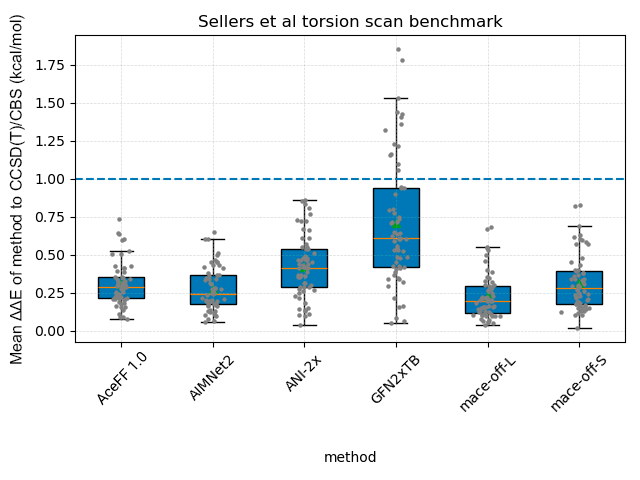
Evaluation with QuantumBind-RBFE
AceFF™ 1.0 was evaluated in QuantumBind-RBFE calculations and on torsion scan benchmarks. The preprint defines the datasets, protocols, measures and reported results. We link to the complete study rather than extracting an aggregate accuracy claim.
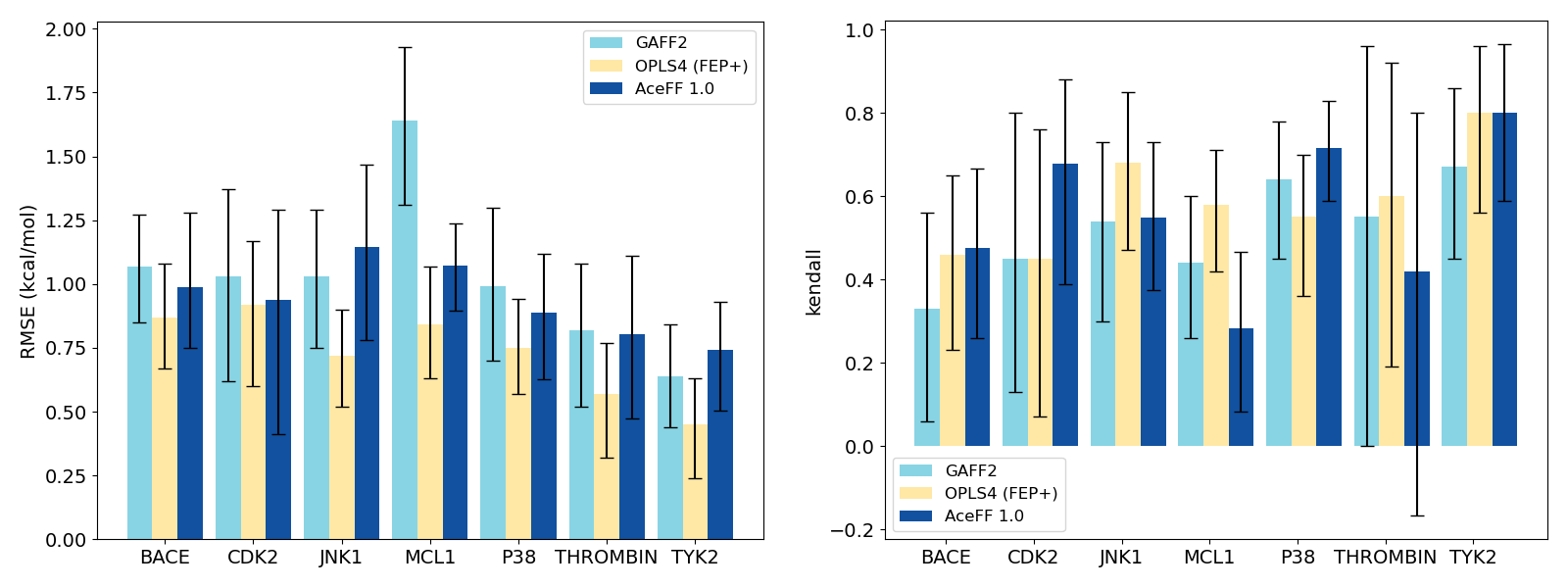
Applications in Computational Drug Discovery
AceFF™ 1.0 integrates seamlessly into computational workflows, offering actionable insights for:
- Screening and prioritizing drug candidates.
- Modeling complex protein-ligand interactions.
- Running molecular simulation with a machine learned ligand potential.
Usage
AceFF™ 1.0 is designed for use in NNP/MM workflows, where the ligand is treated with the neural network potential and the environment with molecular mechanics. It can also be used to simulate pure NNP of small molecules.
- Run ML potential molecular simulations of a small molecule using ACEMD with this tutorial, e.g. to minimize.
- For a tutorial on running mixed protein-ligand simulations, refer to NNP/MM in ACEMD.
- Execute RBFE calculations with QuantumBind-RBFE in an NNP/MM setting with the following tutorial. Further examples can be found here.
Future Developments
Acellera is committed to advancing AceFF™’s capabilities. Plans include expanding the training dataset, enhancing computational efficiency, and enabling simulations with larger timesteps to further optimize the balance between cost and accuracy.
Availability
AceFF™ 1.0 is available for non-profit use and demonstrations, allowing researchers to explore its potential in their projects. The AceFF™ 1.0 model can be found in huggingface.
This blog post is licensed under a Creative Commons Attribution-ShareAlike 4.0 International License, enabling others to share and adapt the material for any purpose, even commercially, as long as appropriate credit is given and any modifications are distributed under the same license.