


One recipe, 20 ADMET leaderboards: AceProp on the Polaris benchmarks
A follow-up to Reaching the top tier of the PXR Blind Challenge with an AI-agent black-box trainer.
After the PXR blind challenge we wanted a broader check. One good result on one endpoint can be luck. So we took AceProp — the molecular-property trainer inside PlayMolecule AI — pointed it at 20 public ADMET benchmarks on Polaris, and submitted every result to the public leaderboards under the name AceProp1. Anyone can go and look them up.
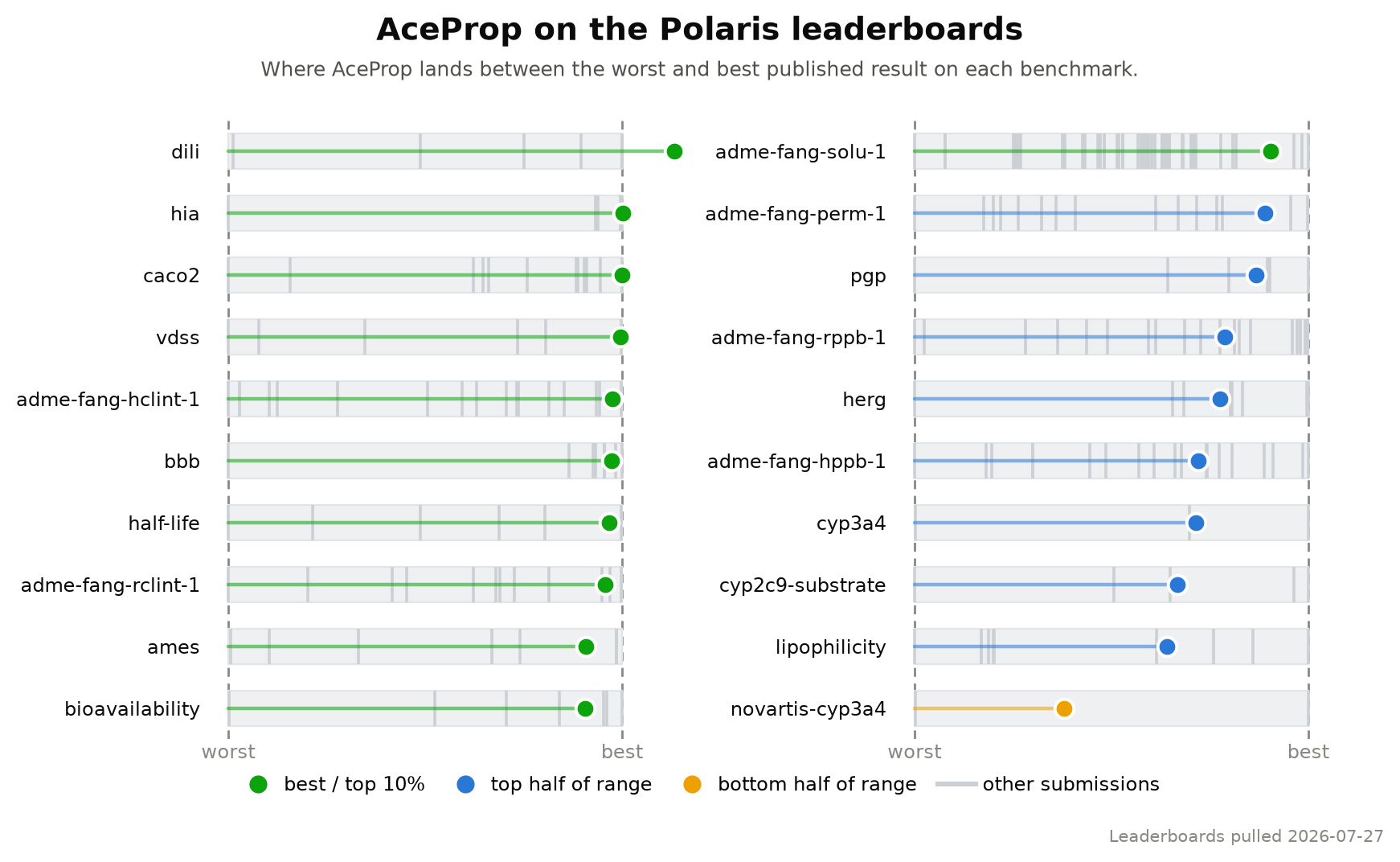
Headline: AceProp is #1 on one leaderboard, in the top 3 on 12 of 20, and in the top 5 on 17 of 20 — against 225 other published submissions, many of them from billion-parameter models built specifically for these benchmarks.
What we tested
Polaris hosts curated ADMET benchmarks with fixed train/test splits and fixed metrics, so submissions are directly comparable. We used 20 of them, covering most of what a project actually needs to know about a molecule:
- Absorption and permeability — Caco-2, HIA, MDCK permeability, bioavailability, solubility, lipophilicity
- Distribution — blood–brain barrier, volume of distribution, human and rat plasma protein binding
- Metabolism — human and rat liver microsomal clearance, CYP3A4, CYP2C9, half-life
- Toxicity and liabilities — hERG, Ames, DILI, P-gp
Metrics differ per benchmark (ROC-AUC, PR-AUC, MAE, Spearman), which is why we report rank within each leaderboard rather than raw scores across them.
How we ran it: no tuning, on purpose
This is the part that matters most to us.
Every one of the 20 datasets was trained with the same single call — the same strategies and settings. Just download the data, train, predict, submit.
That is the whole point of a black box. AceProp handles featurization, model choice, hyperparameter search under cross-validation, multi-seed ensembling and inference on its own. Under the hood the default recipe averages a neural network trained on frozen pretrained GNN embeddings with a gradient-boosted tree model on molecular descriptors — but as a user you don't need to know that, and you don't need to change it per endpoint.
So the comparison below is a bit lopsided in our competitors' favour: many entries on these boards are purpose-built for that specific benchmark. Ours is a default.
Results
The full numbers, sorted by rank:

Three things stand out to us.
Several of the "second places" are ties in practice. On Caco-2 we scored an MAE of 0.27008 against a best of 0.26995 — a gap of 0.0001, far smaller than the noise in the underlying assay. On HIA we matched the leader to five decimal places. On volume of distribution the gap is 0.0005 Spearman. Counting outright wins, AceProp is first on one board; counting "indistinguishable from first", it's six.
It is consistently good rather than occasionally brilliant. 17 of 20 in the top 5, and 17 of 20 in the top half of the field. For someone deciding whether to trust a tool on their own dataset, that flatness is worth more than a single spectacular result: it means the default is a reasonable bet on an endpoint you haven't tried yet.
We are competing against strong models. The submissions above and around us include 1B- and 3B-parameter MPNN foundation models pretrained on LargeMix and Phenomics data, TabPFN-based tabular models, and CheMeleon variants. Matching those with an untuned default, in a single normal training run, is the result we were after.
Where it falls short
Two clear weak spots, and a caveat about the exercise itself.
Plasma protein binding is our worst area. On both human and rat PPB (Fang) we land 9th of 20 — a real gap, not a rounding error (MAE 0.438 vs 0.284 on human). hERG (6th of 9) is a milder version of the same story. If we tuned for these endpoints we'd almost certainly close some of the gap, but the honest read is that the default recipe has blind spots, and this is one.
A public benchmark is not a blind test. Field sizes here range from 3 submissions to 53, so "top 3 of 6" is not the same achievement as "top 3 of 53" — which is why we give the field size on every row. And the splits are public and curated: nothing stops anyone, ourselves included, from overfitting to them over many attempts, and real internal datasets are messier, with fewer compounds, more censored values and series that move over time. We submitted one model per benchmark from a default configuration, which is about as clean as a public benchmark gets, but the blind PXR challenge in our previous post is still the stronger evidence. On your own data, every AceProp run holds out a slice and reports how it scored on it, so you can see what accuracy to expect before acting on a prediction.
Try it on your own data
AceProp is available in the Pro and Enterprise plans of PlayMolecule AI. Point the AI co-scientist at your ADMET or molecular-property dataset and get a trained, tuned, validated model back — the same default workflow that produced every number above. AceProp also ships pretrained ADMET models, so you can score candidate molecules straight away without training anything.
Want to try it on your data? Get in touch at info@acellera.com.
All 20 submissions are public on Polaris under the name AceProp1 (owner f-ace). Leaderboard positions are as of 27 July 2026 and can change as new entries appear.