


Reaching the top tier of the PXR Blind Challenge with an AI-agent black-box trainer
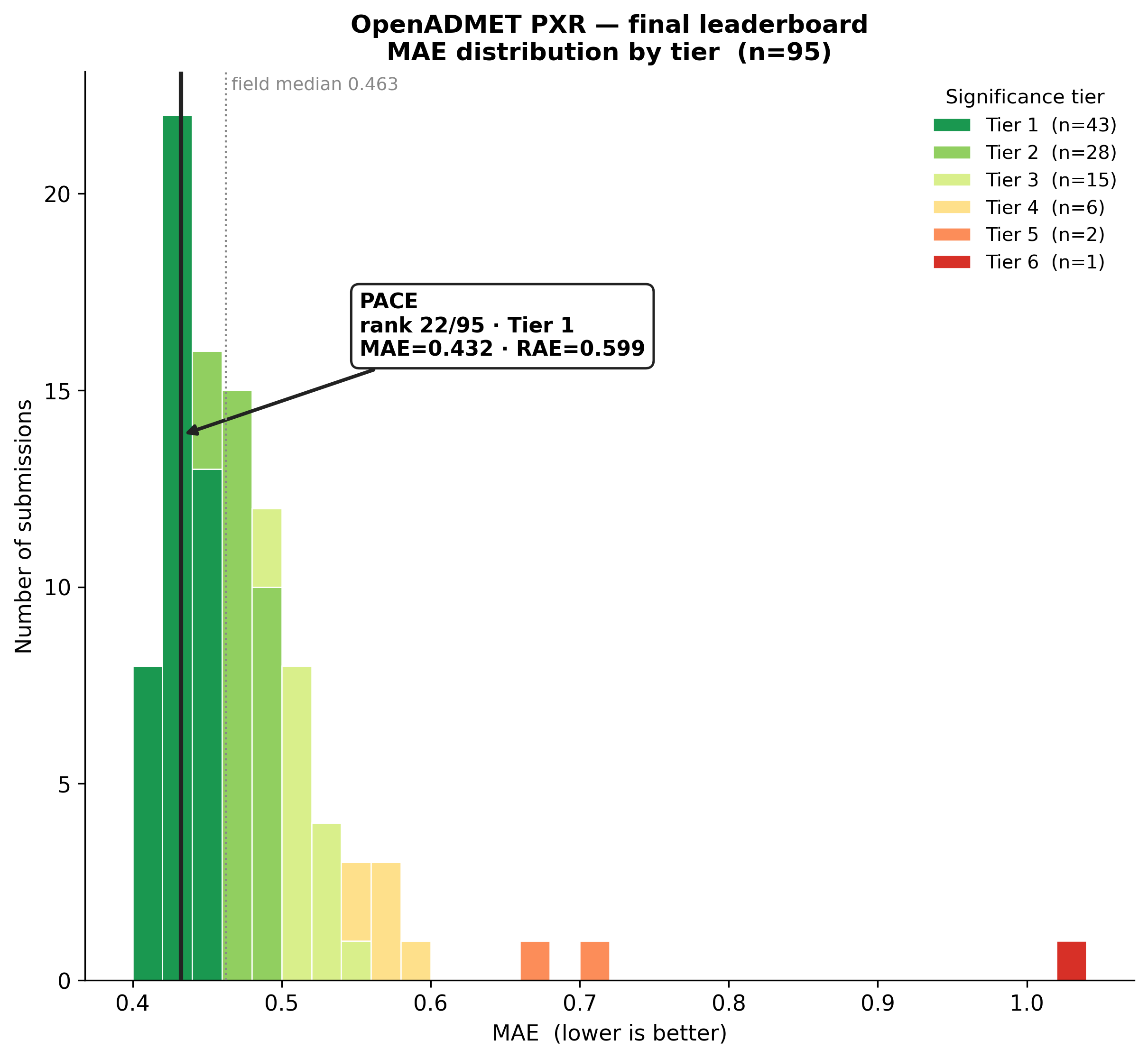
Acellera finished in the top significance tier of the OpenADMET PXR Blind Challenge — statistically indistinguishable from the winning entry — using AceProp, the molecular-property trainer/predictor inside PlayMolecule AI, driven end-to-end by an AI agent and without any proprietary data.
Final placing: #22 of 95 · Significance: Tier 1 · MAE (pEC50): 0.432 · vs. top score: no significant difference
The challenge
PXR (the pregnane X receptor) is a promiscuous xenobiotic sensor and a key anti-target in drug discovery: activating it drives drug–drug interactions. OpenADMET asked participants to predict PXR-activation potency (pEC50) directly from chemical structure, scored on a blind test set of two related analog series. The evaluation ran in two phases — a live leaderboard on one series, then a final, held-out scoring on the other.
How we did it — AceProp, as a black box
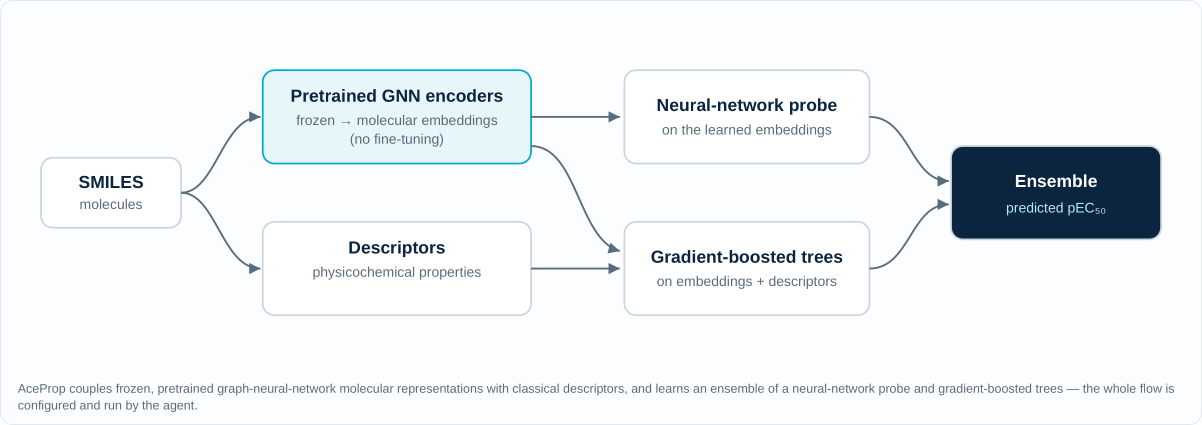
Training was done with AceProp, available in the paid tier of PlayMolecule AI. AceProp is a black-box trainer for ADMET endpoints and molecular properties: you hand it a table of molecules and measurements, and an AI agent orchestrates featurization, model training, tuning and inference — no bespoke pipeline engineering required.
Methodology, in brief
The model is a supervised ensemble that averages two complementary learners: a feed-forward neural-network regressor on frozen pretrained GNN embeddings, and a gradient-boosted tree model on standard molecular descriptors and embeddings. Hyperparameters were selected by automated search under cross-validation, with multi-seed ensembling for stability, per-sample loss weighting to reflect label quality, and a light post-hoc calibration. Training used only the challenge-provided data — no proprietary datasets.
Where we landed — and why the tier matters
On the final leaderboard we placed in Tier 1. The tiers group submissions by statistical significance: Tier 1 (43 teams) collects every entry whose error is not statistically distinguishable from the best — so within significance our result is on par with the top scorer (MAE 0.406 vs. our 0.432). Below Tier 1 the field thins fast: 28 teams in Tier 2, then 15, 6, 2, and a lone Tier 6.
We climbed steadily and, crucially, robustly. During Phase 1 we sat around #40 of ~350 on the live leaderboard; when the full test set was revealed at the end of Phase 1 we rose to #26 of ~350; and in the final blind evaluation we reached #22 of 95, in Tier 1.
A thinning, reshuffling field
The move from a live leaderboard to a blind final was punishing. Two things thinned and reshuffled the field. First, when the full test set was scored at the end of Phase 1, teams that had overfit to the first analog series dropped down the ranking — while our model climbed, sign that it generalized better on data that were not part of the leaderboard. Second, many of the teams sitting in the lower half of that Phase 1 ranking chose not to continue, so only 95 carried into the final Phase 2 evaluation (out of about 350 participants in Phase 1). Holding a top-tier position through both is the result we're proud of.
A candid lesson in generalization
More data is not automatically better data. When Phase 2 released additional labeled compounds — including the now-unblinded first analog series — we folded them into training, expecting a lift. In the end, this slightly degraded our predictions: our Phase 1 model would have ranked several places higher (reaching #9 of 95). The two analog series, though siblings, differ enough that training on one specialized the model, which then transferred imperfectly to the other series.
The takeaway we carry forward: extra data helps only when it matches the target distribution, and a robust, well-generalizing model can beat a more heavily “optimized” one. It is exactly this kind of honest, cross-validated decision-making that AceProp is built to support.
Have ADMET data of your own?
AceProp is available in the Pro and Enterprise plans of PlayMolecule AI. Point the AI co-scientist at your ADMET or molecular-property dataset and get a trained, tuned, validated model back — the same black-box workflow that put us in the top tier of the PXR Blind Challenge, with no proprietary data. AceProp also features pretrained models for ADMET properties, so you can directly score your candidate molecules with these models. Speak to us for a pilot info@acellera.com.