


From PDB to Simulation-Ready: Expanding What Molecular System Preparation Can Handle
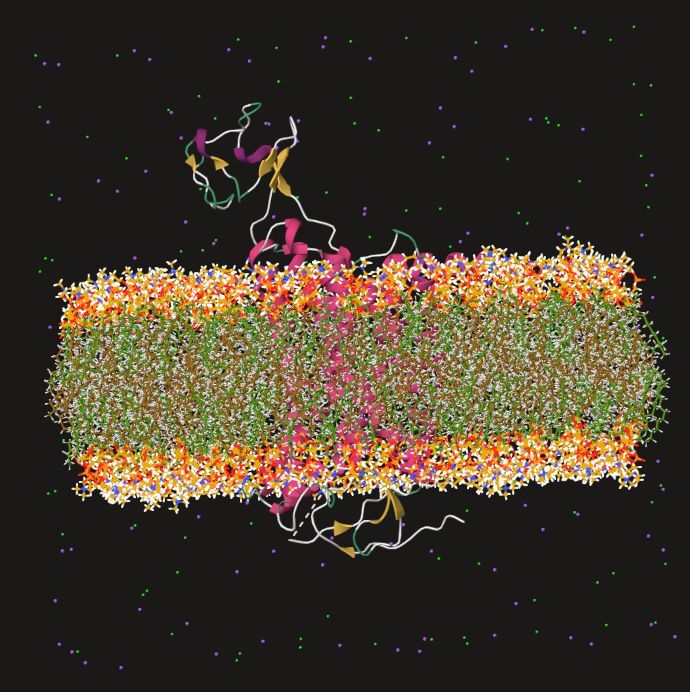
A structure from the Protein Data Bank can look ready for molecular simulation. In practice, it is often only the starting point.
Experimental structures may contain missing regions, incomplete residues, modified amino acids, cofactors, metals, covalent connections, or ligands whose chemistry is not fully described by the deposited file. Hydrogens and protonation states must be assigned. Membrane proteins still need a membrane. Even apparently routine systems can demand a chain of specialist tools and manual interventions before a simulation can begin.
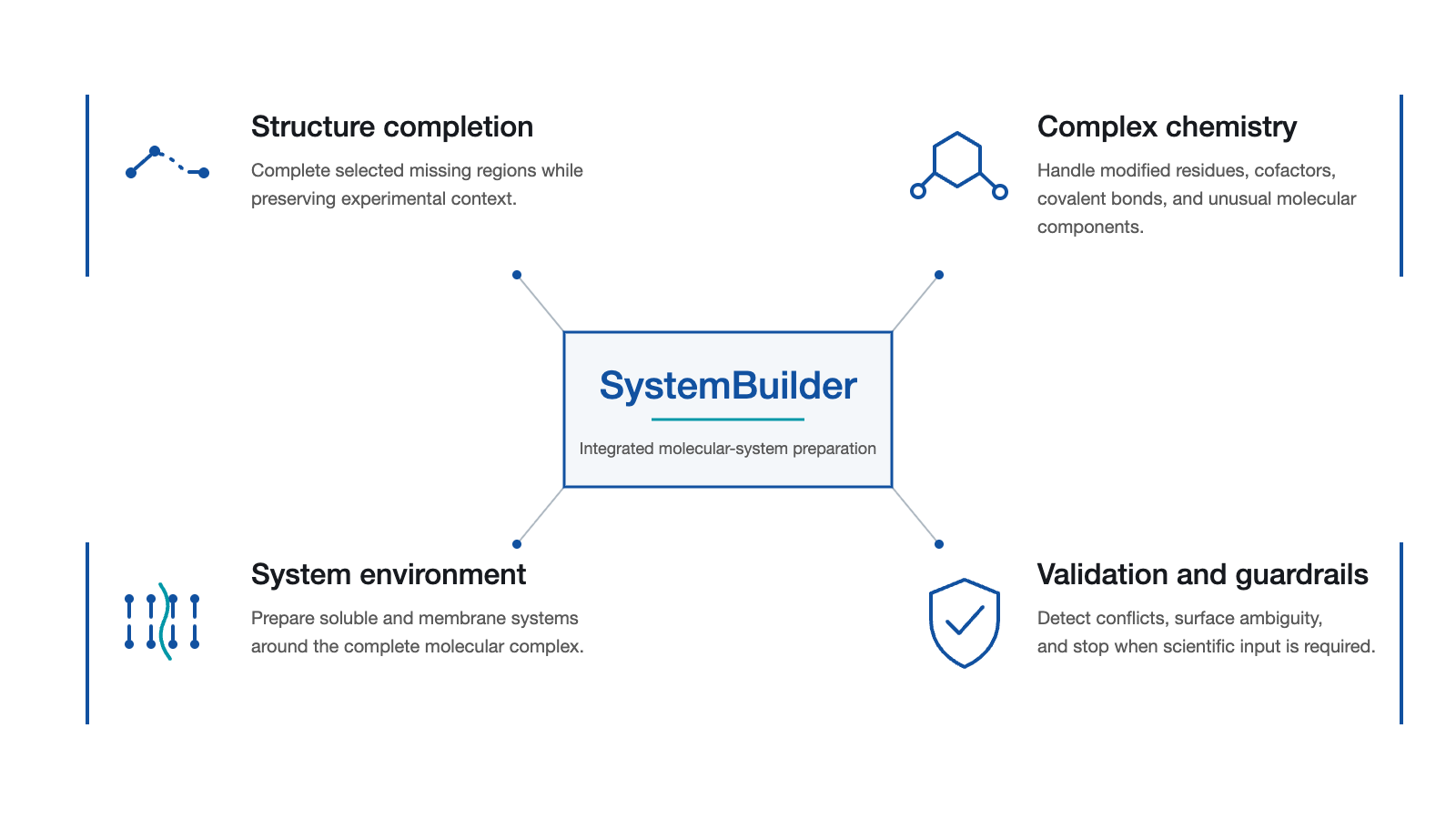
SystemBuilder is Acellera’s new approach to that preparation problem: one entry point for turning a deposited structure into a checked, simulation-ready molecular system.
The important change is not simply that more steps are automated. It is that a much wider range of molecular systems can be handled coherently, while ambiguities and unsupported cases remain visible to the scientist.
Incomplete structures without starting over
Missing loops and unresolved residues are common in experimental structures. Repairing them should not mean rebuilding or disturbing the rest of a carefully resolved complex.
SystemBuilder can identify incomplete regions, let the scientist decide which ones matter for the intended simulation, and generate the selected missing structure while retaining the surrounding molecular system. Deposited ligands, metals, and crystallographic waters can remain part of the preparation instead of becoming collateral damage in a separate repair step.
The resulting model is checked in the context of the full complex. In an internal kinase example, a proposed loop occupied the same space as the bound ligand. SystemBuilder detected the clash and produced a new proposal. The value is not just generating missing coordinates; it is recognizing when a plausible-looking result is unusable in its molecular context.
Chemistry beyond standard proteins
Many biologically interesting systems do not fit neatly into the twenty standard amino acids. Their preparation becomes much harder when modified residues, cofactors, unusual bonds, or covalent ligands must be treated consistently with the rest of the structure.
SystemBuilder extends preparation to systems containing:
• Non-canonical and post-translationally modified amino acids
• Common cofactors and free ligands
• Phosphorylated residues
• Cyclic and stapled peptides
• Isopeptide bonds and other cross-links
• Covalent protein–ligand complexes
It also accounts for protonation in the requested molecular conditions rather than treating every occurrence of a chemical group as interchangeable. When the available structural and chemical information cannot be reconciled, SystemBuilder does not silently invent an answer: it reports the ambiguity and asks for authoritative input.
This is a meaningful capability boundary. SystemBuilder does not currently support glycans, and unfamiliar chemistry may still require information from the scientist. Making those limits explicit is part of producing a system that can be trusted.
Soluble and membrane systems in one place
Preparing the molecular structure is only part of the job. A simulation also needs the appropriate environment.
SystemBuilder can produce a prepared structure or a complete solvated system. For membrane proteins, it can construct the requested lipid environment, account for leaflet composition and protein orientation, and combine the prepared molecular complex with the bilayer. Existing membrane systems can also be incorporated when appropriate.
Keeping these capabilities together reduces the manual handoffs between protein preparation, ligand and residue treatment, membrane construction, solvation, and ionization. It also makes the final system easier to understand as one preparation result rather than the product of several disconnected jobs.
Automation with scientific guardrails
The aim is not a black box that guesses on the scientist’s behalf. Some choices depend on the hypothesis being tested: whether a missing tail should be modelled, which structural information should guide a repair, what membrane composition represents the experiment, or how unfamiliar chemistry should be interpreted.
SystemBuilder automates the mechanical work around those choices while keeping the consequential decisions visible. It can flag structural conflicts, inconsistent chemistry, unsupported molecular features, and problems in the assembled output. When a reliable result cannot be produced, stopping is a feature.
This distinction matters. A completed computation is not necessarily a usable molecular system. Preparation software should be judged by what it catches as well as by what it builds.
From fragmented preparation to a single capability
Within PlayMolecule, protein preparation, parameter generation, and membrane building have historically appeared as separate operations. SystemBuilder brings those capabilities together around the scientist’s objective.
A user can begin with the structure they want to study, describe the intended conditions and environment, and receive either a prepared molecular structure or a full simulation system. The result is accompanied by the decisions, warnings, and checks needed to understand whether it is ready for the next stage of research.
The broader ambition is straightforward: make sophisticated molecular-system preparation available without requiring every scientist to become an expert in the plumbing between specialist tools.
For standard proteins, that means a faster route to a checked starting point. For modified, covalent, cofactor-rich, or membrane systems, it means bringing cases that once required bespoke preparation into the same guided experience.
That is the capability SystemBuilder is designed to deliver: more of the molecular systems researchers actually want to study, prepared in one place, with scientific judgment kept in the loop.
Have a molecular system that is difficult to prepare? Request a 15-minute PlayMolecule AI walkthrough and see how the co-scientist handles your structure.