
How we created our AI co-scientist
Published on October 7, 2026
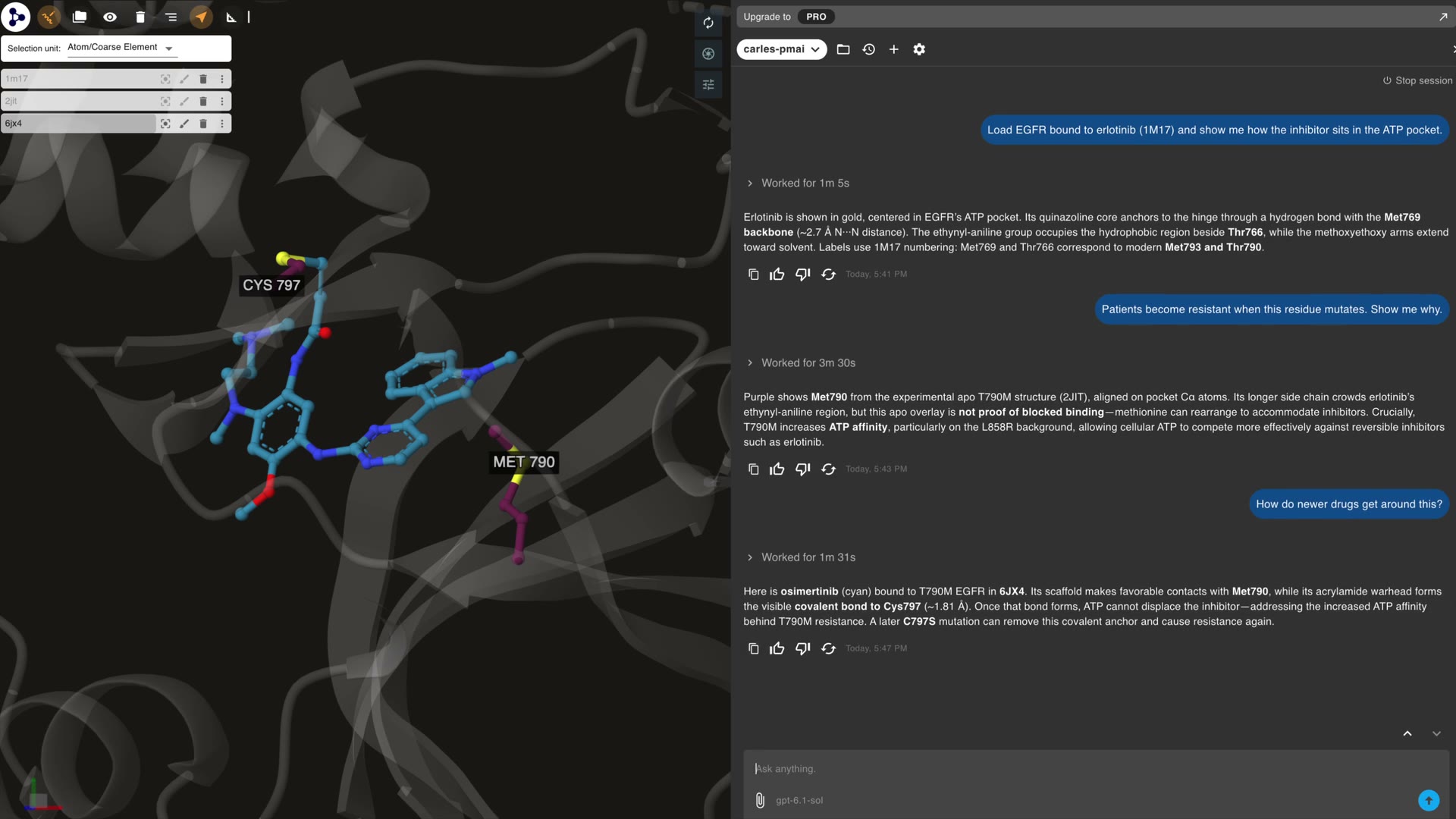
PlayMolecule® AI is Acellera's AI co-scientist for computational drug discovery. It works alongside you in the 3D molecular viewer. It searches the literature, structural and bioactivity databases and helps you create a mental model of a molecular system. This post explains why we built it, how it works, and what scientists can do with it.
By Carles Navarro
Why we built an AI co-scientist
A year ago at Acellera, we started using reasoning LLMs for molecular discovery, at a time when frontier models were beginning to have enough scientific knowledge to be useful in real-world scenarios. At the same time, the first coding agents started to shine: they could execute code, run commands and write analysis code with little supervision. As computational chemists, we understood this was a big opportunity, as agents could use most of our internal software, analyze the results, reason about them and draw meaningful scientific conclusions. So we wanted them to work with us in a shared platform, where human and AI scientists could work side by side with a shared understanding of molecular systems.
Building that shared understanding matters because explaining how a ligand binds to a protein requires knowing where the binding site is, how the ligand sits in it, which interactions hold it there and how the structure changes between states; this involves reading literature, computing properties and analyzing results. It also means building a three-dimensional mental model of the protein by looking at it, asking questions and moving around the system.
For these reasons, we built the PlayMolecule AI harness around the PlayMolecule viewer, creating a workspace where scientists and agents work together on the same molecular system and build a shared scientific world model. Agents can load, manipulate and see structures in the viewer, while scientists can move around the system, select regions and ask questions about them. In this way, the viewer becomes a communication channel: the scientist and the agent work as two colleagues would in front of the same screen, showing each other parts of the structure as they try to understand a protein or a complex.
PlayMolecule AI changes what individual scientists can do: medicinal chemists have a very good understanding of a system and an intuition for molecular interactions, but they often do not write code; with the co-scientist they can analyze data, ask questions and iterate over the results until they develop a deeper understanding. On the other hand, computational chemists can already run these analyses, and the co-scientist can contribute chemical and biological knowledge, proposing molecules and hypotheses they can discuss and test, or help them improve their own code. In both cases, the co-scientist supports the scientist in areas beyond their usual expertise, helping them become a full-stack scientist.
How we built the co-scientist harness
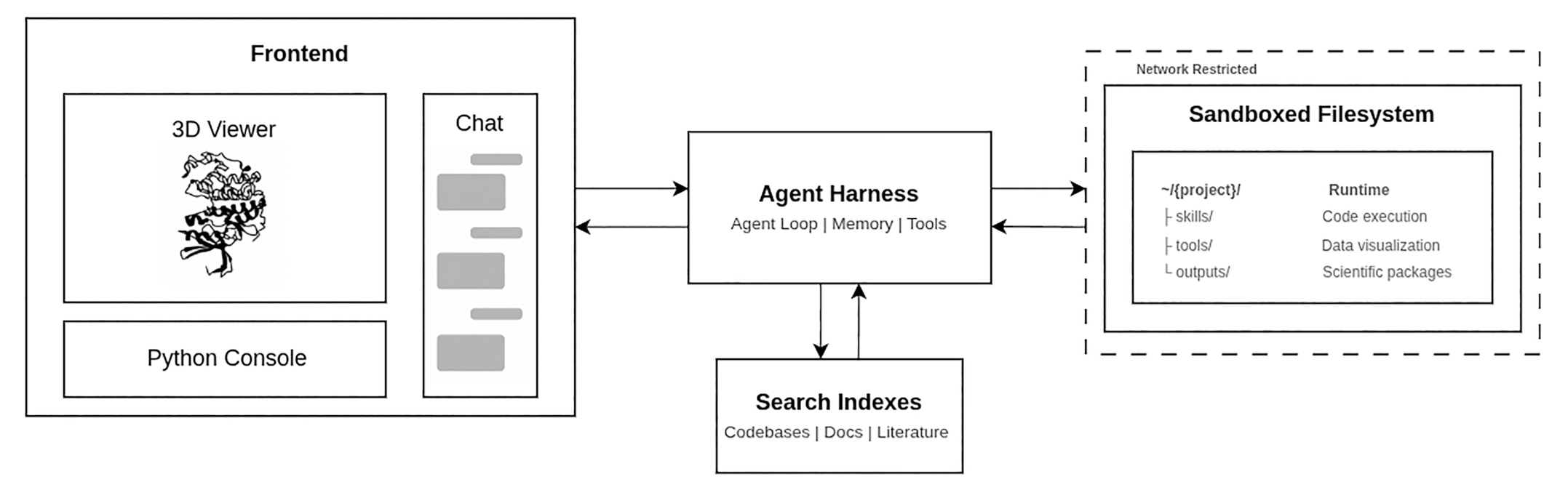
When we started building PlayMolecule AI, we gave the agent scientific tools, from retrieving structures and analyzing interactions to comparing compounds and processing experimental data. However, we soon realized that the number of tools was growing very fast and bloating the model's context. These tools exposed fixed scientific operations, making it difficult for the agent to compose and program its own workflows. Moreover, we had to anticipate which operations scientists would need and build a tool for each one, constraining the agent to our own assumptions about how the work should be done.
Coding agents were showing that a limited set of tools and access to a computer were enough to do very complex work, so we decided that this was the way to go. We gave the agent a computer: tools to run commands, read and write files, and use our scientific software. The agent could then write the code each analysis required, combine different libraries and adapt its approach to the question, with much more freedom to work.
Giving agents this freedom also meant building an environment where they could execute code in isolation: each session runs in its own container, with limited computational resources and access only to the scientist's project files. The scientific software is already installed, and network access is restricted to approved scientific databases and literature services. The sandbox became the agent's working environment, where it can retrieve data, run analyses and keep the files produced during a project.
Then, we started building Acellera's Skills to teach agents how to use our resources, run drug discovery protocols and analyses, write reports and produce scientific figures. Skills use progressive disclosure: the agent initially sees a short description of each skill and reads the full document when it becomes relevant. This allows us to build a growing knowledge base without putting all its contents into every conversation.
The PlayMolecule viewer runs in the browser and combines the Mol* molecular viewer with its own Python environment. The harness connects to the viewer through a WebSocket bound to each session, and the agent has a small set of viewer tools: it can run Python code in the viewer to load, select, align and style structures, take screenshots that are returned to the model, and save objects from the viewer back to the project.
What scientists can do with it
With PlayMolecule AI, scientists can work through questions together with the agent in the viewer, looking at the structures and results and deciding what to explore next. They can also give the agent a larger research question and let it plan the analysis, collect the data and prepare a report that they can read, check and share.
In the EGFR session shown earlier (Figure 1), three questions take us from how erlotinib sits in the ATP pocket to why the T790M mutation causes resistance and how osimertinib overcomes it. At each step, the agent loads, aligns and labels structures, connecting its explanation to what the scientist sees.
In our paper, Speak to a Protein (Navarro et al., 2026), we explored ligand selectivity between the dopamine D2 and D3 receptors (Figure 3). The agent aligned representative structures, labeled the residues that differ between their binding pockets and built a table of known D3-selective compounds from ChEMBL, suggesting which compounds might exploit these differences.
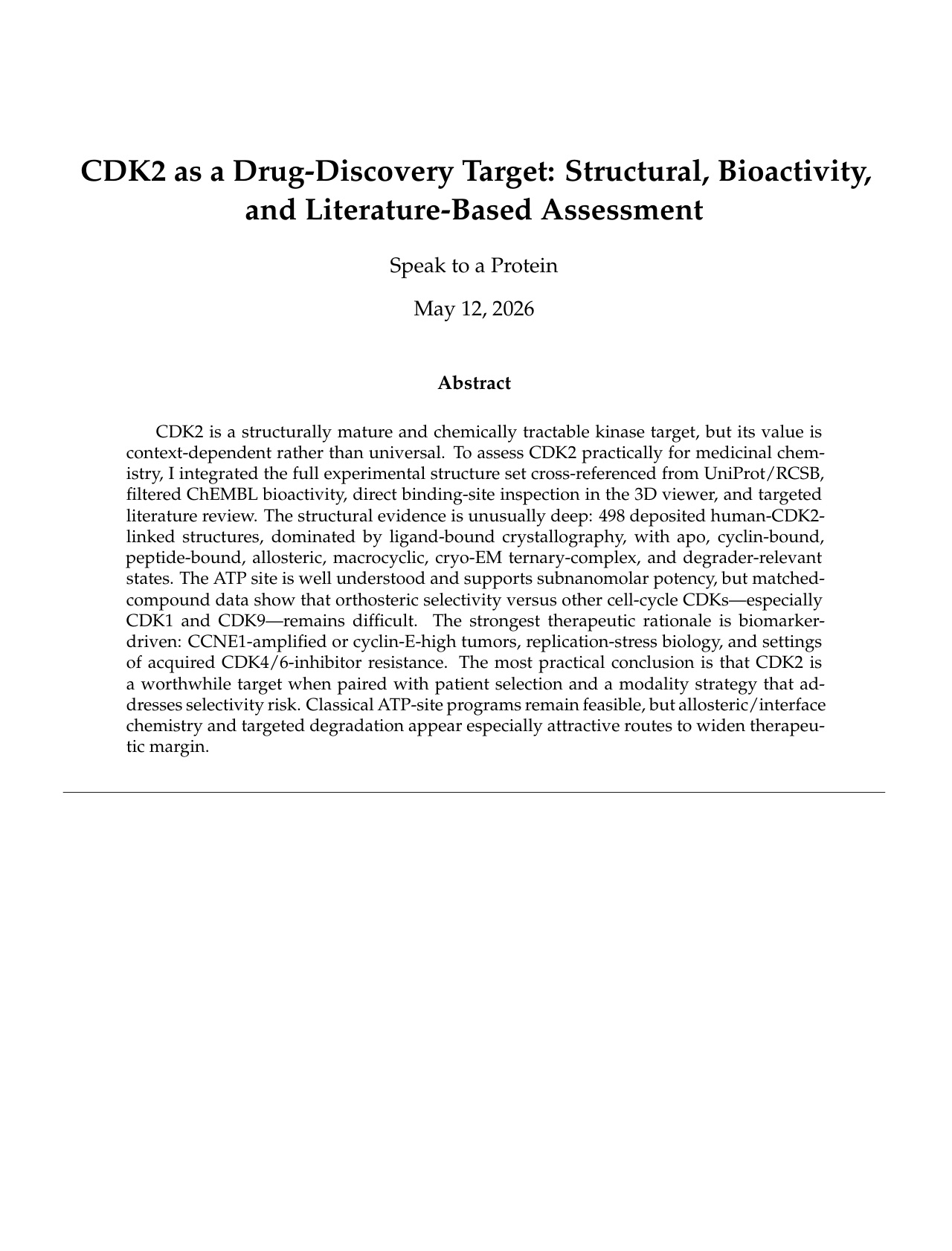
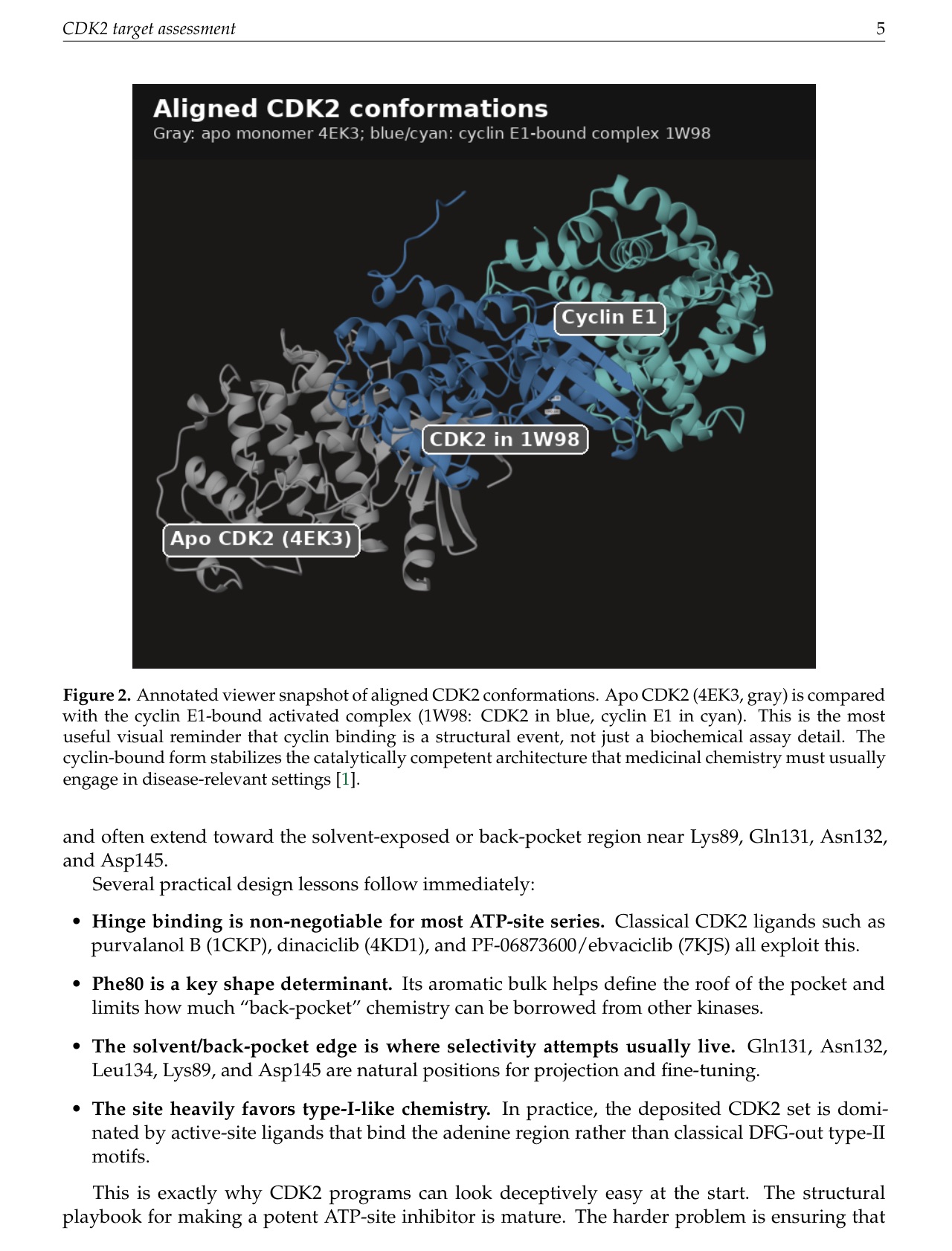
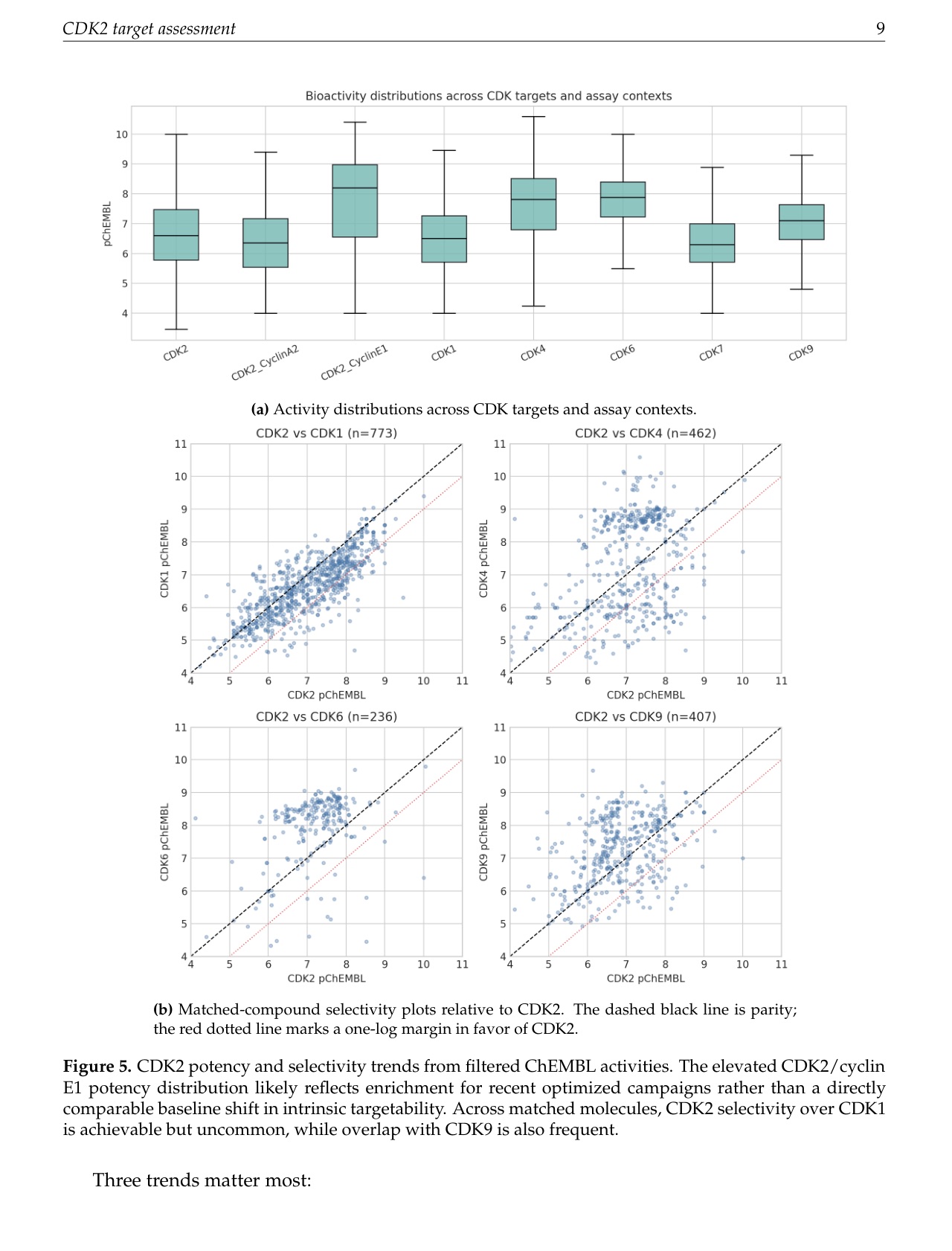
We also asked the agent in a single prompt to evaluate CDK2 as a drug-discovery target and gave it no further input. It wrote its own research plan and worked through about 500 structures and 3,400 activity records. It used the viewer to compare informative structures and illustrate the binding sites, then compiled a LaTeX report for medicinal chemists. The report brings together the structural analysis, selectivity data and literature in one document; Figure 4 shows some of its pages.
Speak to a Protein described the first version of our co-scientist, focused on helping scientists understand proteins through literature, structural analysis and questions in the viewer. Since then, we have continued developing Acellera's co-scientist for longer projects and more difficult tasks. It can now create teams of agents that work together, run computational chemistry jobs on dedicated CPU and GPU resources, and keep working for days. This allows it to work alongside scientists on molecular dynamics, relative binding free energy (RBFE) calculations and entire drug discovery campaigns.
Speak to a Protein (Navarro et al., J. Chem. Inf. Model., 2026). The code for the results reported in the paper is available on GitHub
PlayMolecule AI for academic research
Our paid academic program is now available through PlayMolecule AI for researchers who want to bring the co-scientist into their day-to-day work.
Use the referral code
WinterIsComing@acellera.com to get
bonus usage.
Offer valid for the first 100 customers and until December 31, 2026.