
Exp2: Can an AI-Lab do hit-identification?
Published on October 20, 2026
AI Labs / Experiment 02
I gave a team of independent AI agents a target product profile and resource limits. They chose the next steps; I followed their progress through a shared wiki and a molecule leaderboard.
AI Paper: Read the full project report (PDF)
Gianni De Fabritiis · CEO, Acellera
In my first experiment, I compared AI systems on a demanding scientific task: producing a target product profile (TPP) and discovery strategy for the IL23 interaction with its receptor. The outcome was that the better the underlying model, the better the TPP and PlayMolecule AI produced. That gave me a starting point for a second experiment.
Once the target product profile was done, how far could I go by setting up a team of AI agents to do the discovery work?
The TPP was the only scientific starting brief I supplied. I set up a virtual lab powered by PlayMolecule® AI, with agents working under my supervision. I wanted to see whether the team could develop the investigation from that brief: explore the scientific evidence, propose molecular ideas, test them computationally and work out what to investigate next..
Give the lab a scientific objective
The target product profile, or TPP, describes the properties we would want a proposed medicine to have and the measurements that would guide its development. Here, the aim was a small molecule that could interfere with the interaction between IL23 and its receptor, a signaling pathway relevant to psoriasis.
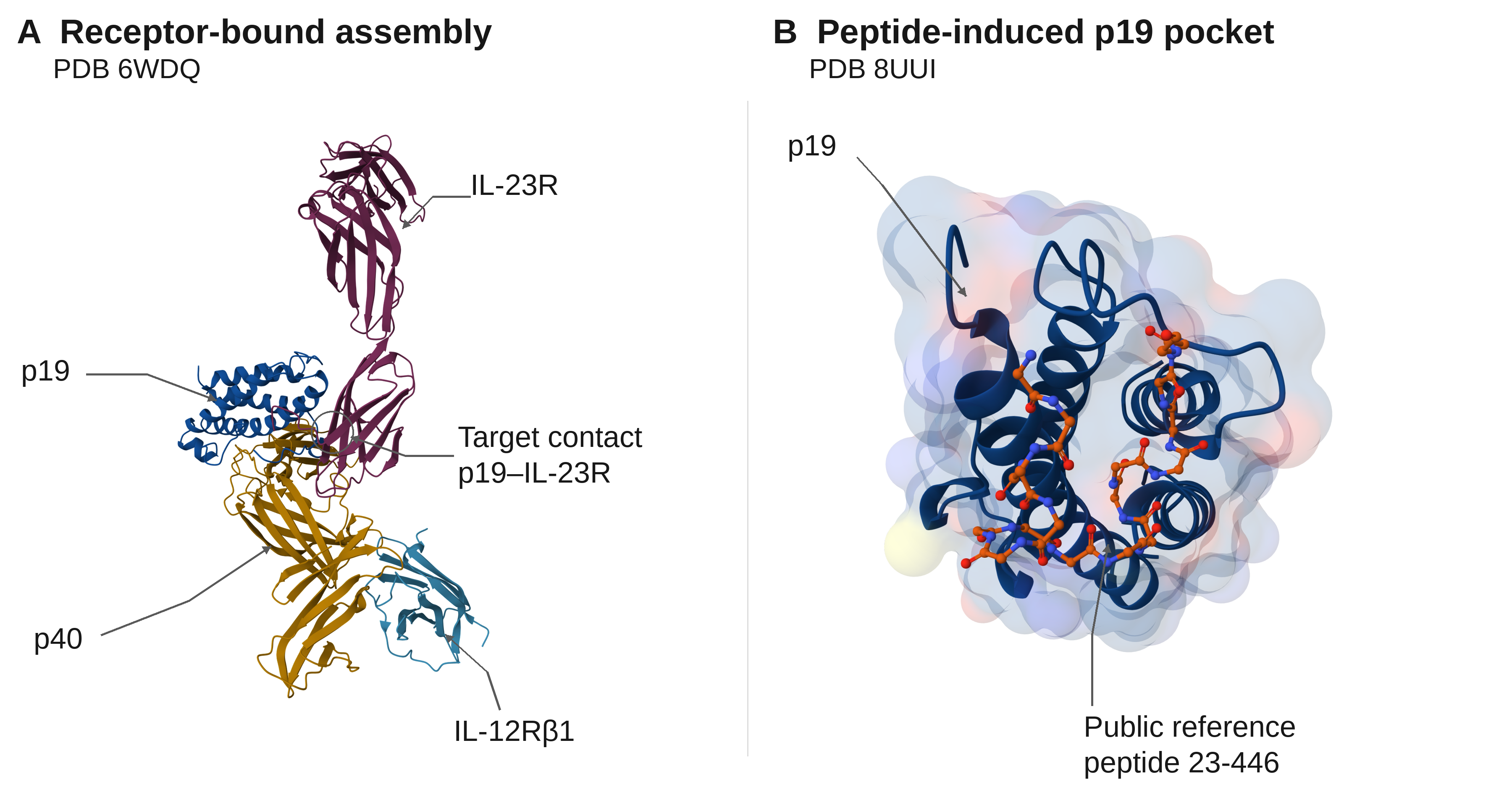
The structural evidence offered several possibilities the AI-Lab had to evaluate. One was a pocket on the p19 component of IL23, revealed by an inhibitory peptide. Another was the corresponding receptor surface. Whether a small molecule could exploit either route was a question for the investigation.
The AI lab had access to computational tools for examining those ideas. Its work spanned structural analysis, molecular design, docking, molecular dynamics and relative binding free energy calculations. My role was to operate and supervise this experimental track, which ran separately from Acellera’s scientific team.
For most of this experiment, I used GLM-5.3-flash to keep costs manageable. That choice also came with limitations. I encountered errors and situations where the model’s capabilities constrained the work. I set a maximum of four GPUs and ten concurrent agents. I ran the lab on and off for roughly a month, during September and the beginning of October. In total, the experiment consumed 7 billion tokens. This was a preliminary test with a modest setup.
How I ran the lab
I kept the operating instructions in an AGENTS.md file. They defined the goal, how the agents should work together, what they should remember and when to stop. The instructions evolved slightly during the experiment; this is the representative reconstruction included in the manuscript.
AGENTS.md
The instructions behind the experiment
GOAL: Engineer the best small molecules based on the target product profile (TPP) of a small-molecule inhibitor therapeutic for the IL23R-p19 interaction for psoriasis at the preclinical level.
TERMINATION: I will evaluate a leaderboard of the best molecules to make 20. Work autonomously towards the GOAL till I stop you.
MEMORY: Maintain a wiki-like responsive HTML structure with internal links summarizing everything known and learned (the campaign memory) and state.
TEAM of INDEPENDENT AGENTS:
- FRONTEND AGENT: The frontend agent (PlayMoleculeAI) creates agents and communicates with them and with me. The lead does not do the team’s work.
- INDEPENDENT: Agents autonomously try to solve the GOAL, define their own next steps, and test their own ideas.
RESOURCES: The team shares a budget of a maximum of 4 GPUs and 10 concurrent agents.
Source: Table 2 of the updated manuscript. The initial aim was to select 20 molecules to make; the later purchase review used a five-compound budget. The resulting proposed panel is described below.
The brief gave the agents responsibility for choosing their own next steps and testing their own ideas. PlayMolecule AI coordinated the team and communication with me. That division of work was central to what I wanted to explore.
The team maintained a linked HTML wiki as its shared memory. It recorded what was known, what had been learned and where the investigation stood. A molecule leaderboard brought together the emerging candidates and the evidence supporting them.
I mainly followed progress by reading the wiki or asking the coordinator to show me the leading molecules and their evidence. I gave very little guidance on individual calculations. I retained the decisions about when to stop the campaign and which proposals to consider for synthesis.
What the agents actually carried out
The work below emerged across the team as the agents pursued the objective. It developed from broad exploration into increasingly specific questions about individual molecules and their proposed behavior, including new designs, repeated calculations and a separate comparison of alternatives under common preparation conditions.
These categories describe what the team carried out. The wiki and leaderboard gave me a way to follow the investigation across those activities.
The work of the AI lab
Recorded activities and outputs from the computational campaign
| Work undertaken | Recorded output | Why it mattered |
|---|---|---|
| Maintain shared knowledge | A linked HTML wiki recording findings and current state, plus a molecule leaderboard with supporting evidence. | Share findings across the team and give me a common place to inspect progress. |
| Explore structural possibilities | Investigated the pocket on IL23 and the receptor surface. | Develop alternative hypotheses for interfering with the interaction. |
| Build a molecular library | Assembled 2,429 molecular records and retained 2,426 after curation. Later work explored related chemistry and new designs. | Create concrete molecular proposals that could be examined computationally. |
| Prepare and dock molecules | Prepared structural inputs and generated eight early docking tables with 48,500 pose and score records. | Compare possible placements across the modeled sites. |
| Run molecular dynamics | Built simulation systems and tested proposed placements. The three primary candidates each completed three separate 40 nanosecond production runs. | Examine whether particular placements persisted across repeated simulations. |
| Compare related compounds | Completed local relative binding free energy calculations, alongside rejected or discordant comparisons. | Examine local comparisons and identify where disagreement limited the interpretation. |
| Revisit alternatives | A separate 23 entry comparison produced 230 conformers, 4,600 docking poses and 138 scored structures. | Reassess molecular states and placements using a common prepared set. |
| Revise after review | Reconciled molecular identities and execution records. Withdrew affected interpretations when attribution and analysis errors were identified. | Establish which outputs could support a scientific decision. |
| Propose experiments | Recommended three primary compounds, with two additional exploratory options. | Connect the computational evidence to distinct questions about binding and receptor interference. |
The investigation changed as evidence came back
The interesting part was how these activities connected. A proposed molecule led to a simulation. Its behavior raised a question about the intended mechanism. Examining that question could change the next calculation or the experiment being proposed.
One receptor example illustrates this. The molecule remained associated with the protein surface during simulation, but it did not durably preserve the position needed to obstruct the approaching natural partner. Surface association and interference with receptor recruitment had to be examined separately. That distinction helped shape the experimental recommendation.
Operating the lab also required checking the record of what had actually run. A later review found completed simulations behind a stale failure summary, while a separate follow on simulation proposal had been prepared but never submitted. Those differences matter when deciding what evidence is available for the next scientific question.
Review exposed errors too. Some early results had been attributed to the wrong molecular identities, and a distance unit error affected two trajectory analyses. The affected conclusions were withdrawn. This was supervised work, and the record does not establish that the agents detected or resolved every problem independently.
I mainly followed the wiki and asked to see the leading molecules with the evidence behind them.
A preliminary result, and a useful test of the harness
The campaign produced a proposed experimental panel. Three primary compounds had repeated computational support for their particular pocket placements, under their respective evaluation criteria. Two additional options explored different questions on the receptor side.
The experiment was also very useful in exposing issues in the harness: the software that organizes the agents, gives them access to tools and supports their work together. One problem was that the agents were too uniform. They could choose their own next steps and still approach the problem in similar ways. Having ten agents did not automatically give me ten distinct approaches to the investigation.
These observations gave us concrete issues to work on in the design of the lab. We have since substantially expanded its capabilities, and I plan to run a further experiment with more resources.
We still need physical measurements to establish binding and interference with the intended interaction. We also lack a matched comparison and complete resource accounting to quantify any saving in time or cost.
This preliminary test showed me what a team could carry forward when I supplied the objective and reviewed its evolving evidence. It reached a concrete experimental proposal and exposed limitations in both the models and the harness. The next experiment will let me examine how far the expanded capabilities can take the work.