
AcepKa: from pKa prediction to protonation-state preparation
Published on October 1, 2026
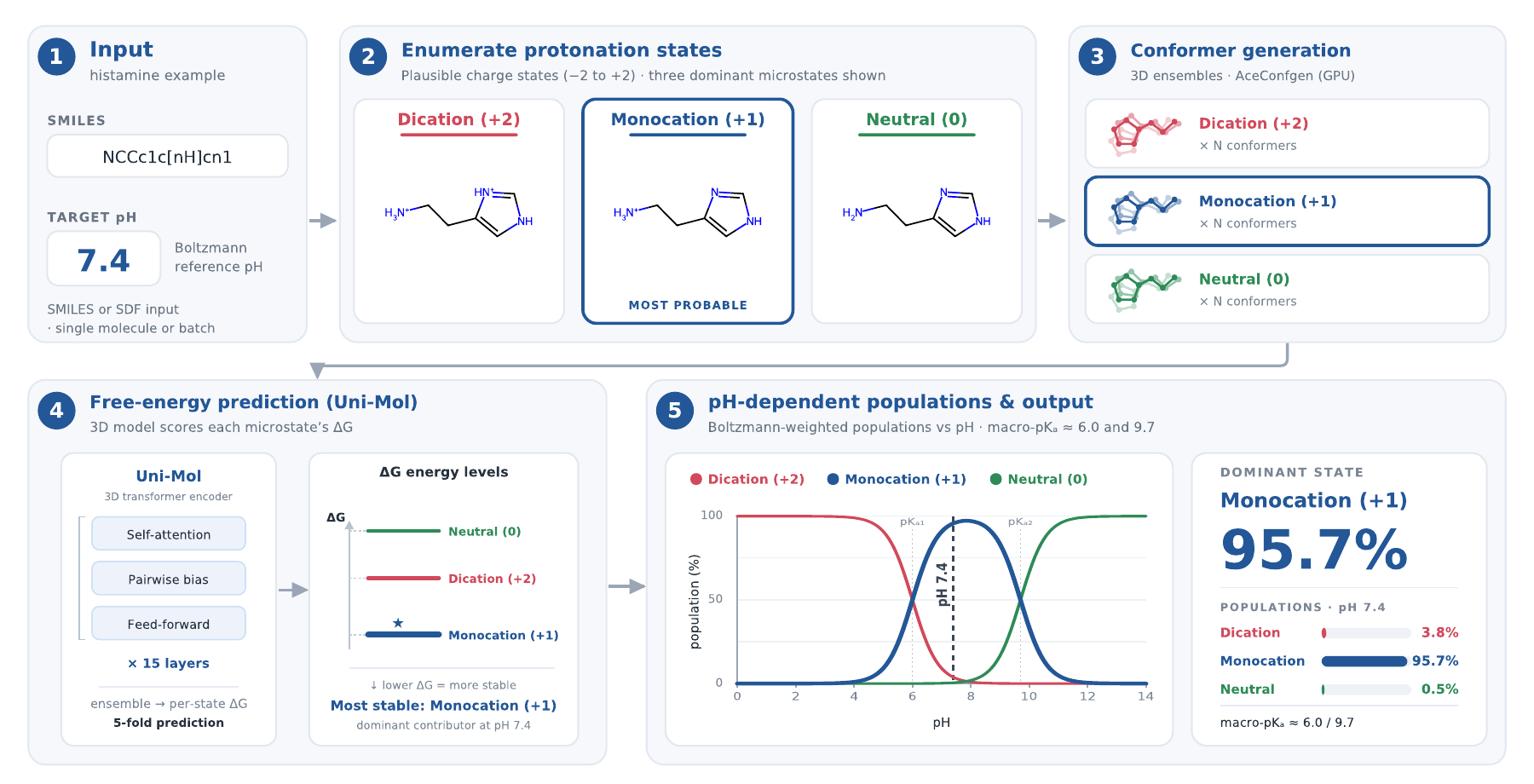
Our new paper in the Journal of Chemical Information and Modeling presents AcepKa, an application for predicting pKa values and preparing molecular protonation states in PlayMolecule® AI. It brings thermodynamically consistent predictions, GPU-accelerated conformer generation and preservation of ligand poses into one workflow, from a single molecule to a compound library.
Protonation affects solubility, permeability and the interactions a ligand can make with a protein. Before docking or molecular dynamics, a practical question is which protonation state to use at the pH of interest. When several states are populated, understanding that distribution can help decide which forms deserve further investigation.
Thermodynamically consistent pKa prediction
AcepKa builds on the Uni-pKa framework, which connects molecular representation learning with statistical mechanics. It enumerates protonation microstates, generates their 3D conformers and uses a Uni-Mol neural network to predict free energies. Those energies determine the macroscopic pKa values and the relative population of each microstate as a function of pH. This shared free-energy description keeps predictions thermodynamically consistent across coupled ionization sites.
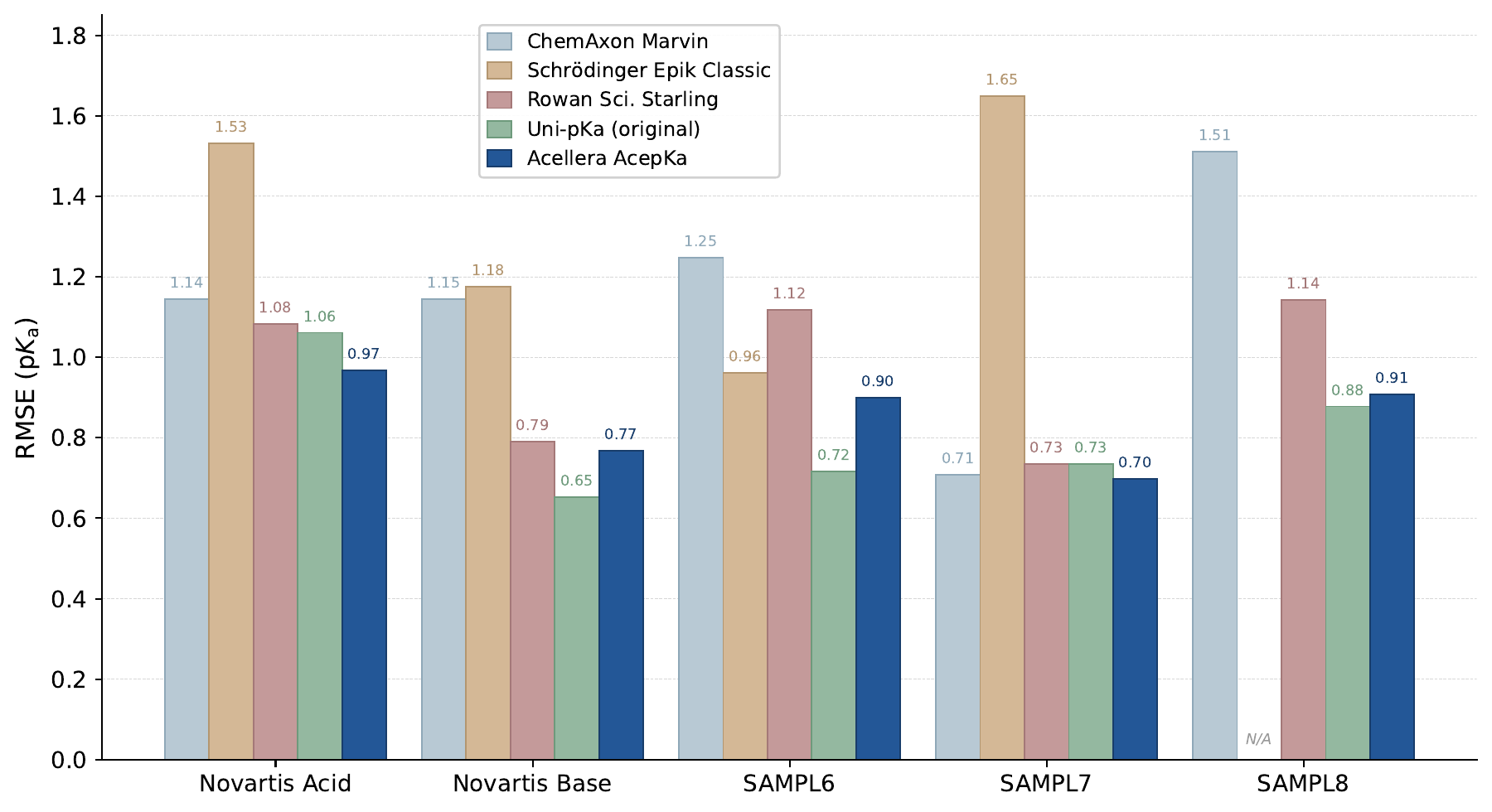
We independently retrained the model and made the resulting five-model ensemble available through AcepKa. In the paper's evaluation, its root mean square error ranges from 0.70 to 0.97 pKa units across the Novartis Acid, Novartis Base, SAMPL6, SAMPL7 and SAMPL8 datasets. The results are comparable to the published Uni-pKa results and leading commercial tools on these benchmarks. The contribution is a directly usable implementation of that methodology, with engineering improvements for molecular preparation.
Making conformer generation practical at library scale
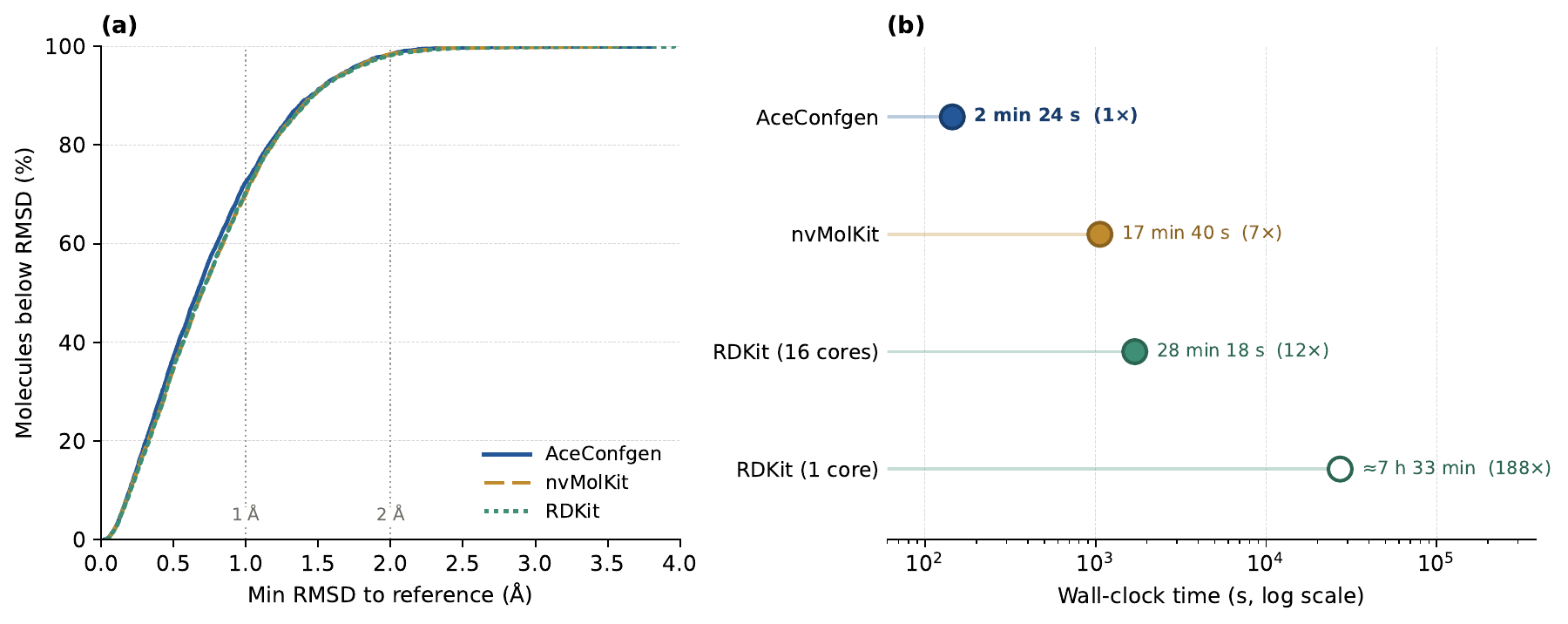
Each enumerated microstate needs 3D conformers, so conformer generation can become a substantial part of the computational cost. We developed AceConfgen, a GPU-native implementation of distance geometry and MMFF94 minimization, to accelerate this step.
The reported benchmark requested 50 conformers for each of 4,548 molecules in the Platinum 2017 dataset. AceConfgen generated all 227,400 conformers in 2 minutes 24 seconds, compared with 17 minutes 40 seconds for nvMolKit 0.4.0 and 28 minutes 18 seconds for RDKit using 16 CPU threads. Both GPU tools ran on a single NVIDIA RTX 4090. That is approximately 7× and 12× faster conformer generation, respectively, with essentially identical accuracy in reproducing the reference bioactive conformations.
From a single molecule to a prepared library
AcepKa accepts SMILES strings or 3D structures in SDF files and a target pH. Its two modes support different preparation tasks:
- Single-molecule mode returns macro-pKa values, pH-dependent microstate populations and the most populated state at the requested pH.
- Library mode returns the most populated protonation state for each input molecule at the requested pH.
For a ligand from a crystal structure or docking result, the 3D mode applies the predicted protonation state and hydrogen placement while preserving the input pose. The prediction uses the ligand alone: the protein environment is not an input, and pocket-induced pKa shifts are not modeled.
Try AcepKa in PlayMolecule AI
Run AcepKa directly through the web interface, or ask the PlayMolecule AI co-scientist to call it as part of a ligand-preparation workflow. You can inspect the resulting structures in the molecular viewer before taking them into downstream calculations. Browser access requires an account and no local installation.
Try AcepKa in PlayMolecule AI or read the full paper for the methodology, benchmarks and implementation details.
Publication
Pesce, F.; Farr, S. E.; De Fabritiis, G.
AcepKa: Thermodynamics-Informed pKa Prediction and
Protonation-State Generation in PlayMolecule AI. Journal of Chemical Information and Modeling,
October 1, 2026. DOI: 10.1021/acs.jcim.6c03037.