

AceFF-2-OMOL: Advancing the Pareto Front of MLIPs for Biomolecular Simulation
Published on November 11, 2026
Machine learning interatomic potentials (MLIPs) for biomolecular simulation have to be both accurate and fast. Free energy calculations need long simulations and many repeats, so a model that is accurate but slow is of little use. At Acellera we are working to advance the Pareto front: the best accuracy available at each speed.
Our latest step is AceFF-2-OMOL, trained on the public OMol25 dataset. Full details are in our updated preprint [1].
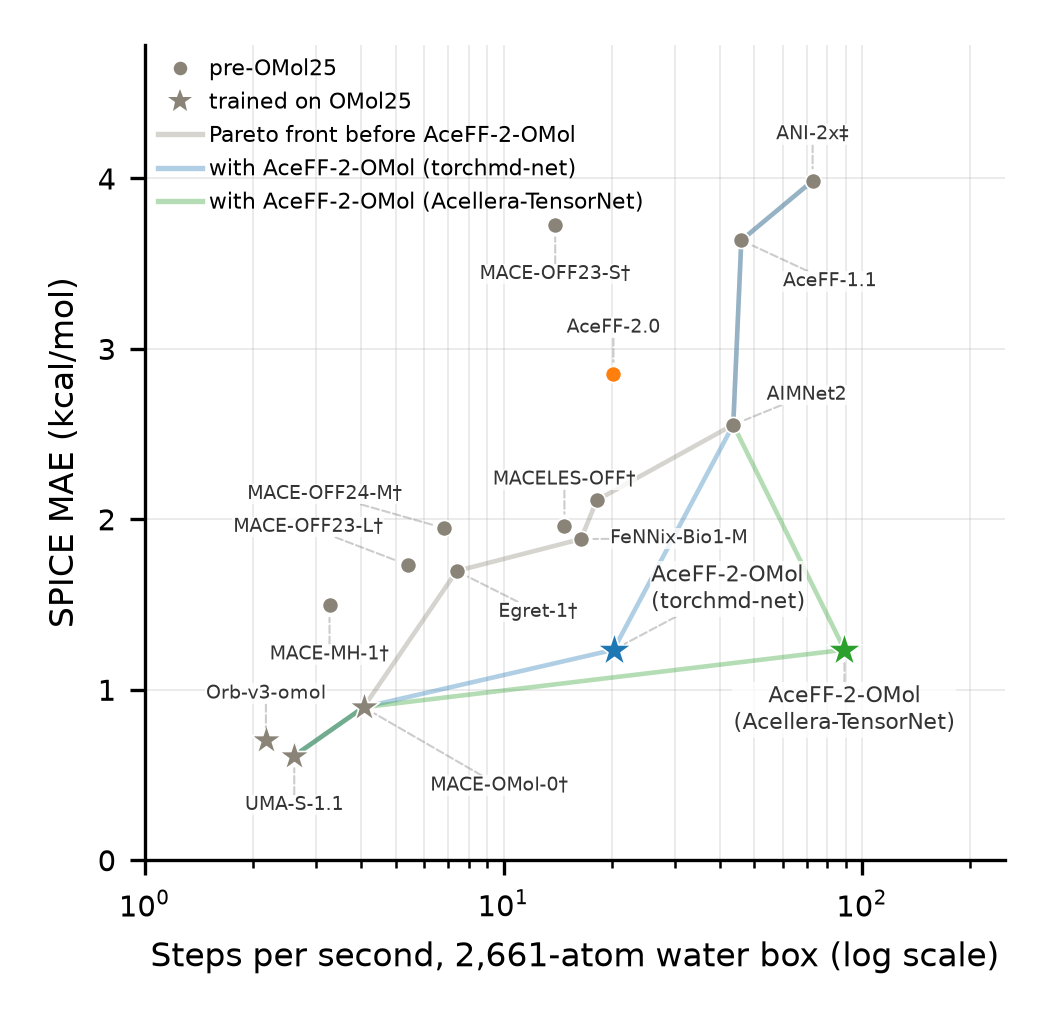
Where AceFF-2-OMOL moves the front:
- Twice as accurate as AceFF-2.0, at the same speed. The SPICE error drops from 2.85 to 1.23 kcal/mol.
- The fastest OMol25 model we tested, at least 5 times faster than the others.
- 4x faster again with Acellera-TensorNet, which pushes the front further out.
How we are advancing the front. Three things make AceFF-2-OMOL both fast and accurate:
- A fast architecture. AceFF-2-OMOL is built on TensorNet [3], an efficient design for machine learning potentials.
- A small model. It has about 1 million parameters, because we train it only on the elements that matter for biomolecular simulation instead of the whole periodic table.
- Optimized CUDA code. Acellera-TensorNet is our own implementation, written from scratch in CUDA to make full use of the GPU. It will be released through PlayMolecule AI.
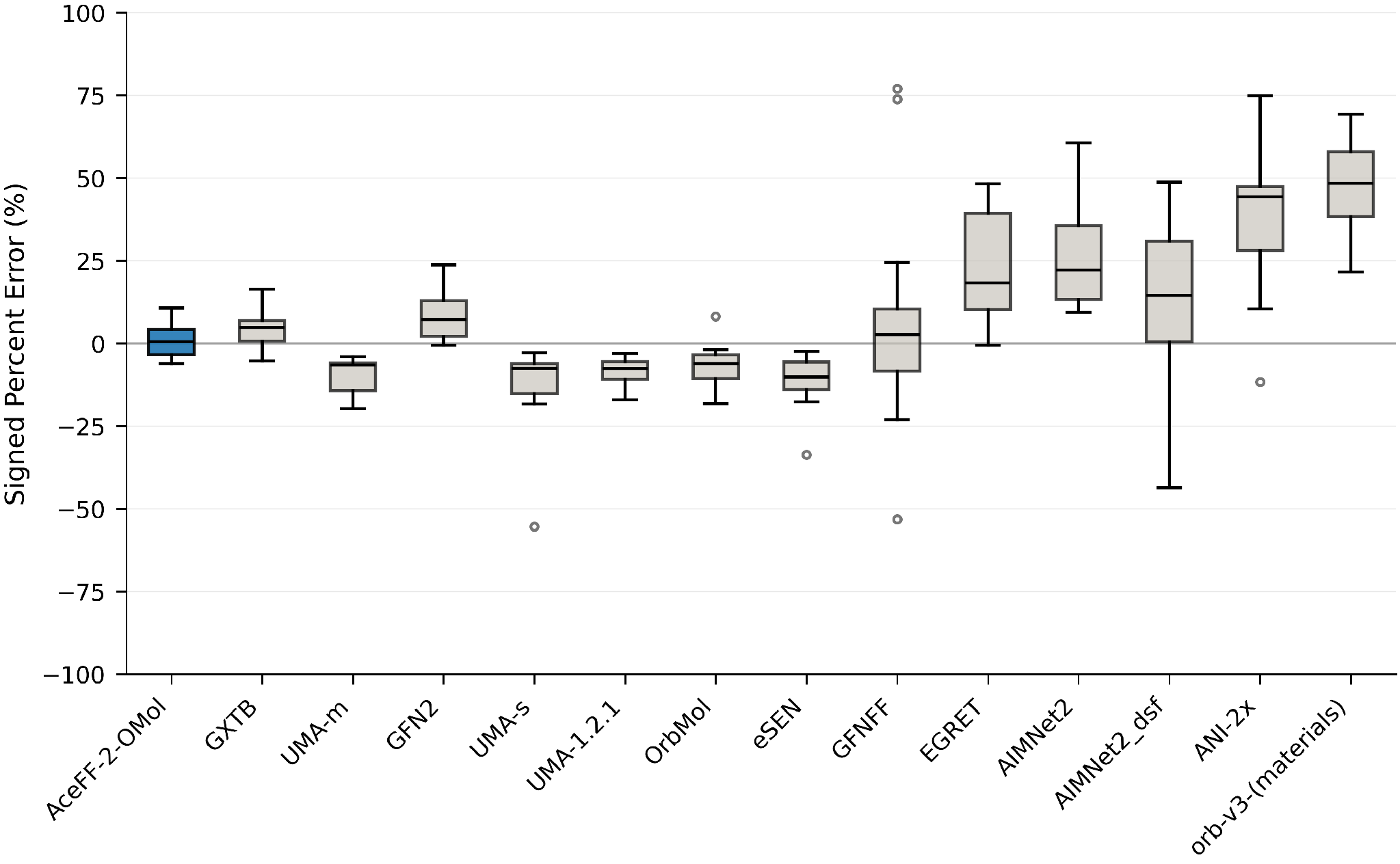
Accuracy where it matters: protein–ligand interactions. On PLA15 [4], a benchmark of interaction energies for 15 protein–ligand active sites, AceFF-2-OMOL has a median signed percentage error of +0.5%, the closest to zero of all the methods we tested. The other OMol25 models (UMA, OrbMol and eSEN) all overbind, with median errors of −6% to −10%. We are not yet sure why AceFF-2-OMOL does not. We think the Coulomb term may help, and the other models may be overfitting. The PLA15 complexes (283–584 atoms) are larger than the OMol25 training structures, so this tests how well each model extrapolates.
AceFF-2-OMOL is one step. We are continuing to work on both accuracy and speed for biomolecular simulation.
Try it now. The model is free on Hugging Face and runs in TorchMD-Net (MIT).
Questions? Contact us at info@acellera.com.
References
- S. E. Farr, S. Doerr, A. Mirarchi, F. Sabanes Zariquiey and G. De Fabritiis, AceFF: A State-of-the-Art Machine Learning Potential for Small Molecules, arXiv:2601.00581v3 (2026). arxiv.org/abs/2601.00581v3
- P. Eastman, E. Pretti and T. E. Markland, Accuracy and Efficiency Benchmarks of Pretrained Machine Learning Potentials for Molecular Simulations, J. Chem. Theory Comput. 22, 6108–6117 (2026). doi:10.1021/acs.jctc.6c00130
- G. Simeon and G. De Fabritiis, TensorNet: Cartesian Tensor Representations for Efficient Learning of Molecular Potentials, Advances in Neural Information Processing Systems 36 (2024). arxiv.org/abs/2306.06482
- K. Kříž and J. Řezáč, Benchmarking of Semiempirical Quantum-Mechanical Methods on Systems Relevant to Computer-Aided Drug Design, J. Chem. Inf. Model. 60, 1453–1460 (2020). doi:10.1021/acs.jcim.9b01171
- Rowan Scientific, pla15-benchmarks, GitHub repository (2025). github.com/rowansci/pla15-benchmarks